

Solutions
Look at every application, then meet the strongest first
The more resumes there are, the more get rejected without being read. The AI Screener analyses all of them and sorts them by a score from 0 to 100%.
Challenge
Two losses in resume screening
Both come from there being no time to read every application carefully. It is a throughput problem, not a standards problem.
- Misses — candidates who simply write about themselves poorly are skipped over
- Delay — nothing moves until every resume is read, and meanwhile another company makes the offer
- Candidates now use AI to write, which makes screening on documents alone harder
01
Register the role
Define the job title and job description as a project
02
Bring in candidate data
Upload the resumes
03
AI screening
Every application analysed
04
Sorted by score
Shown from 0 to 100%
05
Interview from the top down
Your hiring team decides
The three shaded steps are automated. The decision to advance a candidate is made by a person.
Solution
However many there are, all are judged by the same criteria
Every application is analysed against the job description you registered, so nothing gets skipped. They arrive sorted by score, which makes it clearer who to meet first.
- All analysed against the same criteria
- Results shown from 0 to 100%
- Send top candidates an AI interview URL directly
Tuning
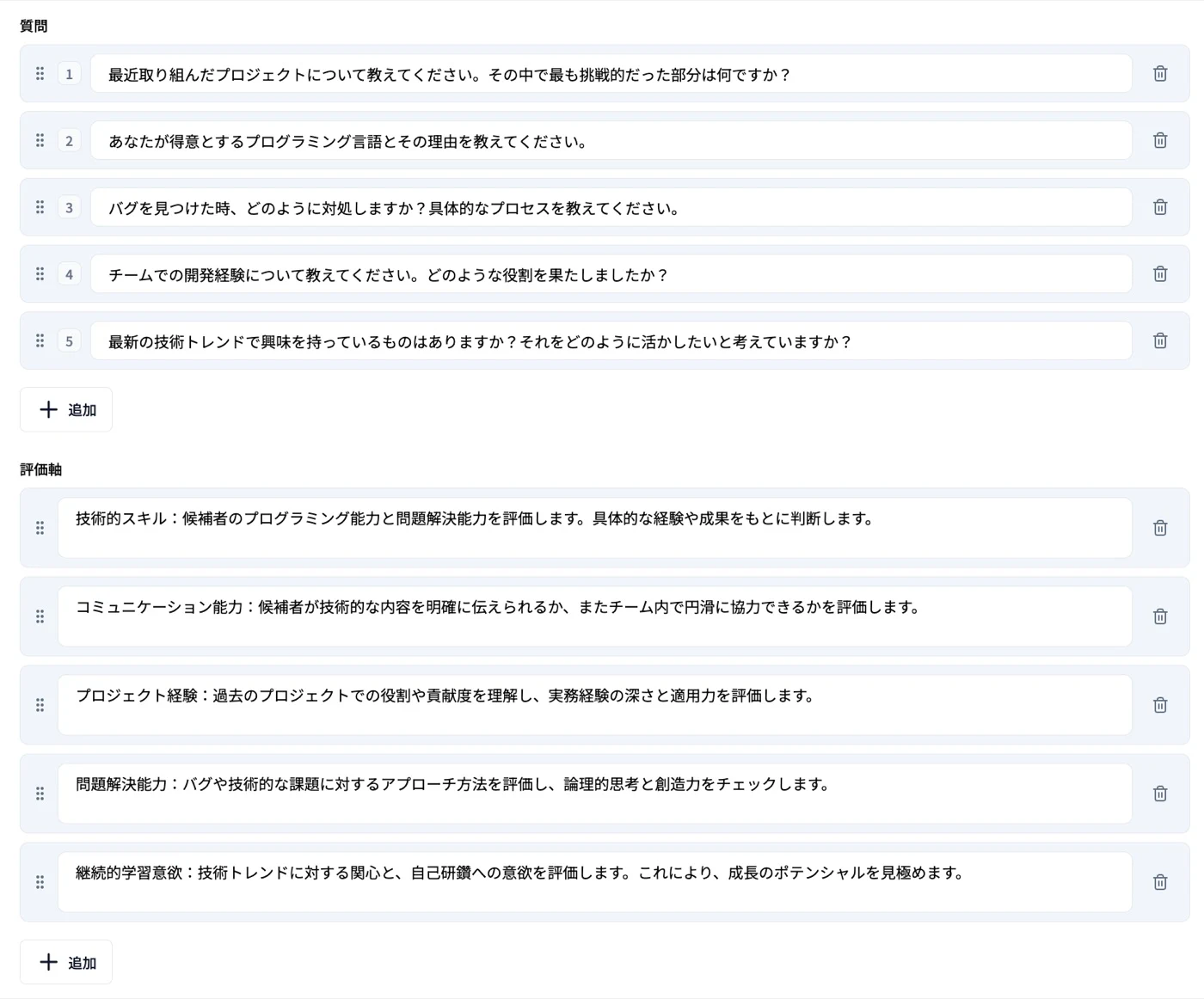
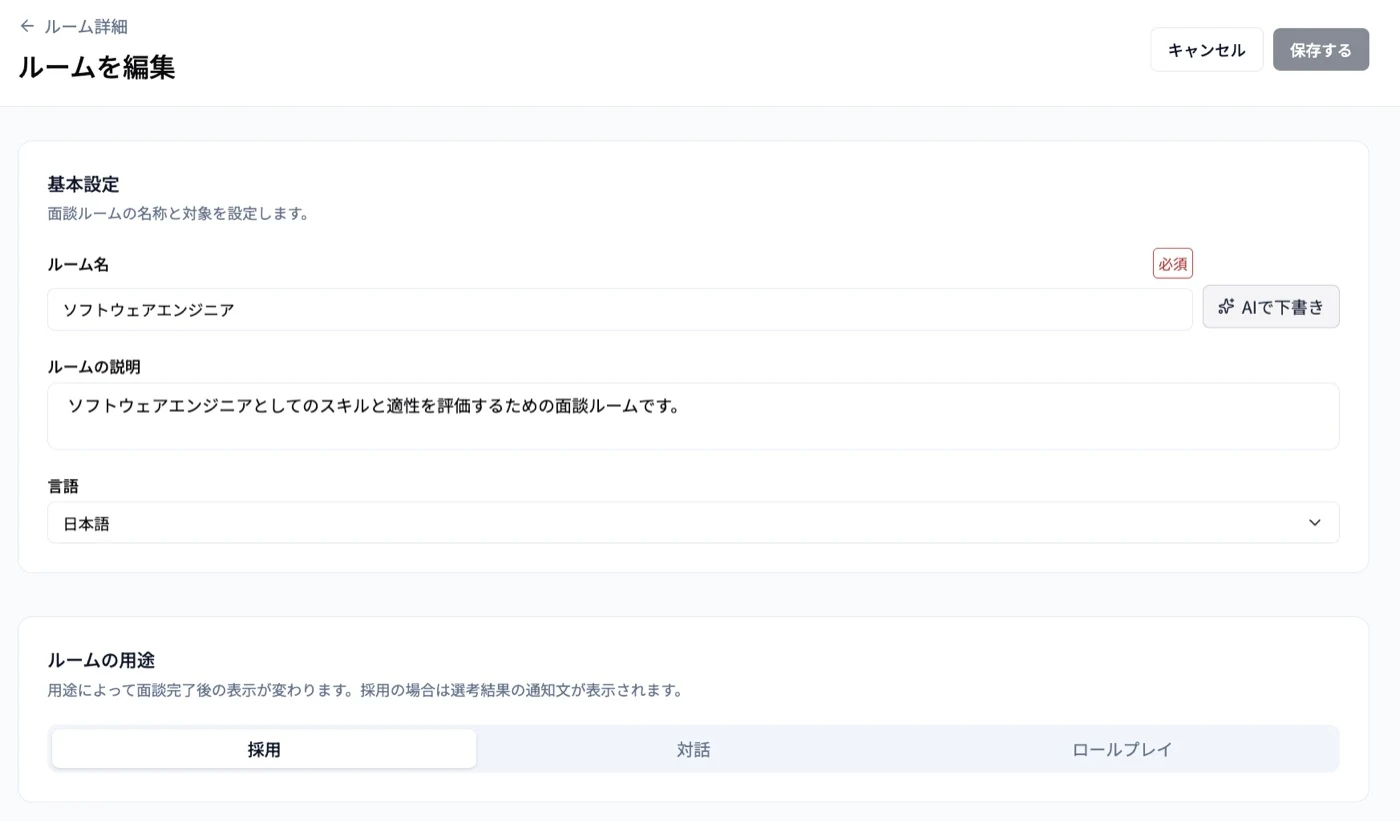
Tune the criteria against your own data
The AI does not learn on its own. You calibrate the evaluation criteria using your own past data, either configuring it yourself or with us alongside you.
- Tune the criteria with your own data
- Configure it yourself, or with us alongside
- No other company’s data enters the picture
Related pages
More detail, by topic
If every application gets a score, you need to be able to explain how that score is given.
Choose an AI interview by whether it can explain its scoring →
Four questions to check what the AI reads and the standard it scores against.
Hand first-round interviews to AI and spend the time on final rounds.
How to choose an AI interview tool →
Who owns the criteria decides which service fits, set out in five layers and six questions.
Frequently asked questions
How is training data handled?
It is not a system that learns by itself. You tune the evaluation criteria using your own past data. You can configure it yourself, or we can work alongside you.
Can we see the reasoning behind a score?
The score for each criterion is kept with written reasoning. Beyond the overall figure, you can see how the candidate was assessed on each point.
Are screening and interviewing connected?
Candidates who come out on top of screening can be sent an AI interview URL directly. Screening and the first interview do not become separate pieces of work.
How much does it cost?
Flex is bought per interview, with a 100-interview minimum. Around 100 is where enough data accumulates for the efficiency gains to show. See pricing details
Tell us how you screen resumes today
We will show how your standards translate into a configuration. Free, about 30 minutes.